
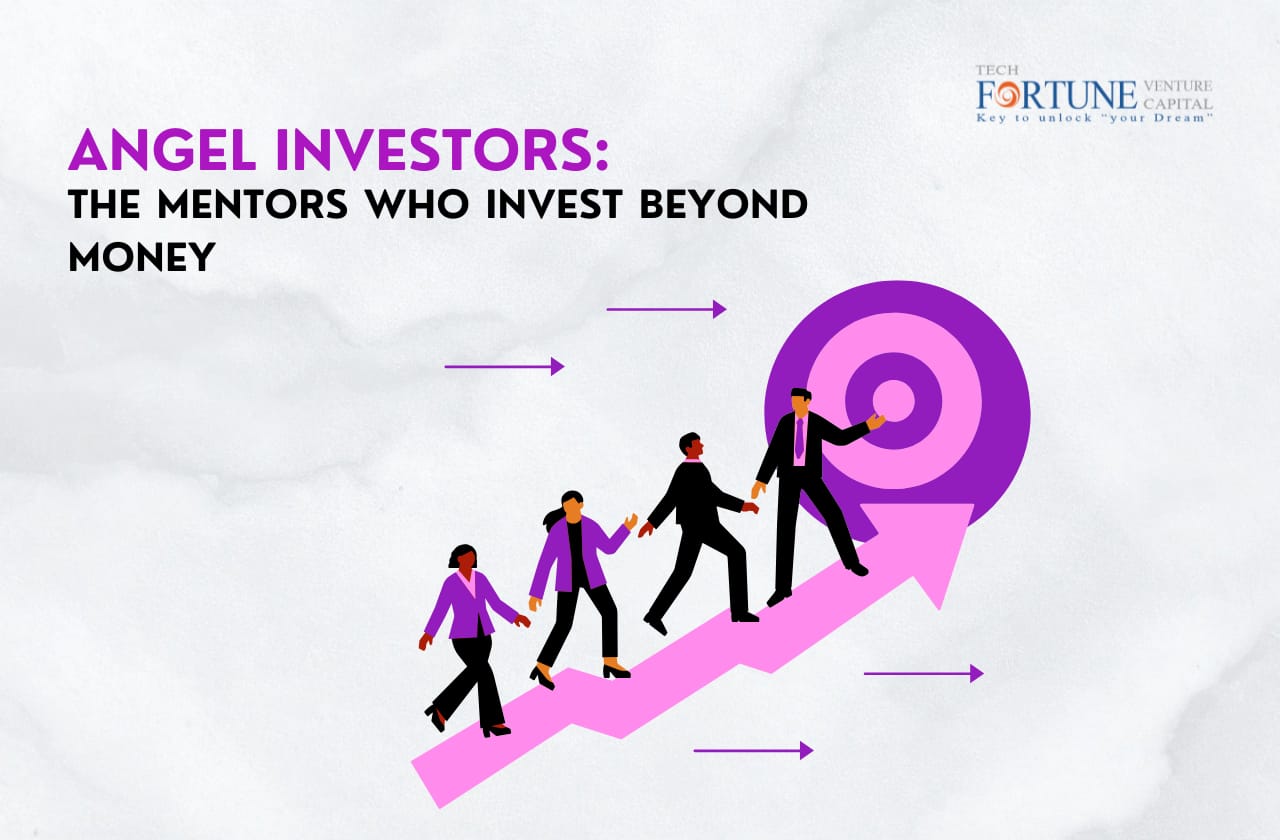
“Angel Investors: The Mentors Who Invest Beyond Money”
“More Than a Cheque, A Turning Point.”
Ask any founder about their first angel investor, and you’ll notice something interesting.
They rarely start with how much money they received.
Instead, they talk about late-night calls, hard questions, unexpected introductions, and that one moment when someone said, “I’ve been where you are. Let’s figure this out.”
That’s the real story of angel investing today.
In a world obsessed with valuations, funding rounds, and headlines, angel investors often play a quieter – but far more transformative – role. They don’t just invest in businesses. They invest in people, potential, and possibilities.
And, this philosophy is deeply reflected in how firms like Techfortune Venture Capital approach early-stage ecosystems – focusing not just on capital deployment, but on long-term founder growth.
Who Are Angel Investors, Really?
At a basic level, angel investors are individuals who invest their personal capital into early-stage startups. But reducing their role to money alone misses the point entirely.
The best angel investors are:
- Former founders
- Industry operators
- Strategic thinkers
- Network builders
- Trusted sounding boards
They’ve navigated uncertainty before. They’ve made mistakes. They’ve learned lessons that no textbook or pitch deck can teach.
This is why their involvement often feels less like “funding” and more like mentorship with skin in the game.
The Early-Stage Reality Founders Face
Early-stage startups don’t fail because founders lack passion.
They fail because they face:
- Ambiguous markets
- Limited resources
- Hiring challenges
- Go-to-market confusion
- Emotional fatigue
This is where angel investors become invaluable.
At Techfortune Venture Capital, the focus has consistently been on early-stage enablement – understanding that at this phase, founders don’t just need money to run faster. They need guidance to run in the right direction.
An experienced angel can help a founder avoid months of trial-and-error with one honest conversation.
Investing Beyond Money: What Angels Actually Bring
1. Pattern Recognition
Angel investors have seen patterns repeat across startups:
- What scales too early
- What breaks when pressure increases
- Which metrics actually matter at which stage
This pattern recognition helps founders make better decisions faster – something capital alone can’t buy.
2. Strategic Mentorship
Great angels guide with insight, asking the questions that inspire clarity and confident decisions.
Great angels don’t just advise — they sharpen thinking. They guide with insight, asking questions that bring clarity and confident decisions.
Instead of saying “Do this,” they ask:
- Why this market, and why now?
- What problem are customers actually paying to solve?
- Are we cutting costs in a way that protects long-term revenue — or silently hurting it?
- Where should capital be invested to unlock growth, not just reduce burn?
- What happens if this assumption is wrong?
Whereas, experienced investors help founders see that cost discipline without revenue vision is risky, and that smart investment is about balance – spending wisely, earning sustainably, and scaling intentionally.
The answers refine thinking and sharpen strategy – not just for tech startups, but across industries.
At Techfortune Venture Capital, for instance, the emphasis isn’t just on funding but on helping founders clarify direction, define priorities, and plan for sustainable growth. It’s guidance that stretches beyond balance sheets and pitch decks.
The Network Effect: Opening Doors That Matter
One of the most underestimated contributions of angel investors is access.
Access to:
- First customers
- Strategic partners
- Future investors
- Domain experts
- Talent
In the early stages, credibility matters as much as capability. When a respected angel or venture ecosystem like Techfortune backs a founder, it sends a powerful signal:
“This founder is worth listening to.”
That signal opens doors faster than cold emails ever could.
Sum Up:
Early-stage ventures often struggle with access: customers, partners, investors, and talent are hard to reach.
Here, angels play another critical role. They connect founders to opportunities that matter.
For tech startups, one introduction can mean early validation, first enterprise clients, or strategic partnerships. For other startups, it could open distribution channels or mentorship circles.
This network effect accelerates growth, credibility, and learning.
Emotional Capital: The Invisible Investment
Startup journeys are emotionally demanding.
Founders carry pressure that rarely shows up on balance sheets.
Angel investors who’ve walked this path understand:
- The fear behind tough decisions
- The loneliness of leadership
- The weight of responsibility
Sometimes, the most valuable contribution an angel makes is simply saying:
“This phase is hard. You’re not failing. You’re learning.”
This emotional reassurance often keeps founders going when logic alone wouldn’t.
How Techfortune Venture Capital Embodies This Philosophy
What stands out in Techfortune Venture Capital’s work is its founder-first mindset.
Rather than chasing trends, the emphasis has been on:
- Sustainable business models
- Long-term value creation
- Founder clarity over hype
By engaging closely with early-stage ventures, Techfortune has consistently supported startups beyond funding – helping them think through strategy, governance, and growth readiness.
This approach reflects a broader shift in venture ecosystems: capital is abundant, but meaningful mentorship is rare.
And that’s exactly where thoughtful angel investors make the difference.
Angels vs Institutions: Why Early Guidance Matters More
Institutional investors often step in when metrics are visible and traction is measurable.
Angel investors step in before certainty exists.
They invest when:
- The product is evolving
- The model is still forming
- The founder is learning
This early belief shapes not just the company’s trajectory, but the founder’s confidence.
When angels act as mentors, they help founders:
- Build decision-making frameworks
- Develop leadership maturity
- Prepare for future institutional conversations
This makes startups funding-ready, not just fund-seeking.
The Compounding Effect of Knowledge
-Money gets spent.
-Knowledge compounds.
When angels share experiences, frameworks, and insights, founders carry that learning forward – into every hire, pitch, and pivot.
This is why mentorship-driven investing creates ripple effects across ecosystems. One well-guided founder often becomes the next generation’s angel, mentor, or ecosystem builder.
Techfortune’s involvement across ventures reflects this compounding philosophy – strengthening not just individual startups, but the broader innovation landscape.
Wrap Up: Building More Than Startups
Angel investors who invest beyond money don’t just fund companies.
-They shape founders.
-They strengthen ecosystems.
-They accelerate learning.
In an age where funding rounds make headlines, it’s easy to forget that behind every successful startup is often an angel who believed early, guided quietly, and stayed involved when things were uncertain.
- If you’re a founder, seek angels who challenge your thinking, not just your valuation.
- If you’re an investor, remember – the most meaningful returns often come from the impact you create, not just the exits you chase.
At Techfortune Venture Capital, this belief continues to guide how early-stage ventures are supported – by investing not only in ideas, but in the people courageous enough to build them.
Find us:
If you’re a founder looking for more than capital – seeking mentorship, strategic clarity, and long-term partnership – connect with Techfortune Venture Capital and explore how the right guidance can shape your growth journey.
FAQ:
Angel investors look beyond ideas and financial projections. They evaluate a founder’s clarity of vision, learning mindset, resilience, and ability to adapt. Many angels prioritize founders who can absorb feedback, make thoughtful decisions, and demonstrate long-term commitment to building value.
In most successful cases, yes. Angel investors often remain engaged through periodic check-ins, strategic discussions, and introductions when needed. The level of involvement varies, but the most impactful angels act as accessible advisors rather than distant financiers.
Angel investors typically engage at the idea, prototype, or early traction stage—when businesses are still shaping their direction. This is the phase where guidance, validation, and early belief can significantly influence how a startup evolves.
While mentors and advisors offer guidance, angel investors combine mentorship with financial commitment. This dual role aligns interests more closely, as angels support growth not only through advice but also through a shared stake in the company’s long-term success.